Minimizing Stress And Anxiety in Dementia: The Function of Smaller Senior Care Environments
Business Name: Beehive Homes of Sandy
Address: 9532 S 700 E, Sandy, UT 84070
Phone: (801) 975-5244
Beehive Homes of Sandy
BeeHive Homes of Sandy provides personalized assisted living and memory care in a comfortable residential setting. Our compassionate caregivers deliver attentive daily support focused on dignity, independence, comfort, and quality of life.
9532 S 700 E, Sandy, UT 84070
Business Hours
One of the most heartbreaking parts of dementia is not amnesia, however the anxiety that typically takes a trip with it. Families will inform you about a parent who paces for hours, asks the exact same concern every five minutes, or becomes frightened when relocated to a brand-new location. As cognitive maps fade, a person leans harder on their environments for hints about what is safe, what is familiar, and who can be trusted.
That is why the physical and social environment of senior care matters simply as much as medications and medical diagnoses. Over the last twenty years working around assisted living and dementia care neighborhoods, I have seen one pattern repeat itself: for lots of people with dementia, a smaller sized, quieter living setting can significantly lower anxiety and agitation.
This is not a magic technique, and it does not work for every single person. However the size and style of a senior care environment forms how the brain has to work to make it through the day. For a vulnerable brain currently operating at full capacity simply to translate standard cues, a substantial structure with dozens of personnel faces and continuous sound can feel like an airport at heavy traffic. A smaller sized, more homelike setting feels closer to a quiet area street.
The details of size, staffing, and routine matter more than glossy sales brochures recommend. Let us take a look at why that is, and how households can use this knowledge when weighing assisted living, memory care, and respite care options.
Why stress and anxiety is so typical in dementia
Anxiety in dementia is typically described as "behavior problems" or "wandering" or "resistance to care." That language misses out on the experience from the inside. When you sit with individuals and really see, you see worry and confusion more than defiance.
Several changes in the brain add to that anxiety:
The initially is decreased ability to process complex environments. A healthy brain filters noise, sights, and motions, letting you concentrate on what matters. Dementia deteriorates that filter. A busy dining room that you or I would call "vibrant" can feel disorderly and threatening to somebody who can not understand the overlapping conversations, clattering meals, and staff rushing in and out.
The second suffers short-term memory. Picture awakening several times every day without any clear concept where you are, unsure who just helped you dress, or why there are strangers strolling previous your door. Even if you are told, you may forget again in a few minutes. That recurring loss of orientation keeps the nervous system on high alert.
The 3rd is loss of familiar roles. A retired instructor who when managed a class, or a parent who ran a family, may now depend on others for the simplest tasks. Loss of autonomy feeds stress and anxiety and sometimes anger. When the environment constantly reinforces that loss, stress rises.
None of this is the individual's fault. It is a predictable result of brain changes. Which likewise indicates that the best environment can buffer those changes rather of magnifying them.
How the care environment shapes anxiety
Family members often focus on medical offerings: "Does this assisted living neighborhood manage insulin?" or "Is this memory care unit secured?" Those are very important concerns, but daily emotional stability normally depends more on subtler environmental factors.
Three components appear over and over in the residents I have followed: the quantity of stimulation, predictability of regular, and consistency of relationships.
Too much stimulus, particularly unforeseeable noise and movement, is exhausting for someone with dementia. Long corridors filled with carts, televisions, overhead announcements, and echoing voices create a consistent sense of "something occurring." The brain keeps orienting, scanning Beehive Homes of Sandy assisted living for dangers, then losing track, then scanning once again. Individuals either closed down or become restless.
Predictable routine is another anchor. When breakfast is constantly in the very same room, with the same location settings and approximately the very same faces at the table, the brain can build a convenient script: sit here, eat this, see that employee, then return to my chair by the window. If the setting changes throughout the day, or staff are continuously redirecting homeowners to new wings or activity spaces, that fragile script falls apart.
Finally, relationships carry an individual more than any physical function. A resident who sees the same 3 or four caregivers every day and discovers, even late in dementia, that "Maria is safe" or "Sam always brings my tea," will lean on that implicit memory even as names and dates disappear. In a big structure with regular personnel turnover and rotating tasks, that relational map never gets a chance to solidify.
Smaller senior care environments tilt these 3 factors in a calmer instructions by style, even when nobody uses those technical terms.
What "smaller" in fact implies in senior care
"Smaller sized" is a slippery word. Households in some cases assume it refers just to constructing size or variety of apartments. In practice, what matters is the variety of residents sharing a home, and the staff group that supports them.
In standard assisted living, you might see 80 to 120 residents in one structure, all sharing a couple of big dining rooms and activity locations. A memory care system within that structure might have 20 to 30 locals behind a protected door. Personnel generally turn among numerous wings or floors.
In contrast, smaller sized dementia care environments pair fewer residents with a mainly constant group in a clearly defined, homelike area. That can take several kinds:
Small group homes. These legally certified homes might serve 6 to 12 citizens, frequently in a home embedded in a residential area. Bedrooms are private or semi-private, and typical locations are merely a living-room, dining room, kitchen area, and yard. Personnel numbers are restricted, so homeowners see the same caretakers daily.
Household design communities. Some bigger senior care campuses embrace a household technique, where the building is divided into separate smaller "homes" of 8 to 16 homeowners. Each home has its own kitchen, dining area, and consistent personnel. Locals hardly ever cross into other homes, so their world stays sized to what their brain can manage.
Boutique memory care. A few stand-alone memory care neighborhoods deliberately top census at lower numbers, often 20 or fewer, and stress smaller sized shared spaces instead of huge multipurpose spaces. They still appear like a center, but style and staffing lean towards intimacy rather than scale.
The core principle is not the square video footage, but the number of faces, sounds, and spaces an individual should track in order to feel oriented.
Why smaller sized environments can decrease anxiety
Across many locals and families, certain benefits appear regularly when people with dementia move from a big, institutional setting into a smaller one. None of these are ensured, but they prevail enough to guide decision making.
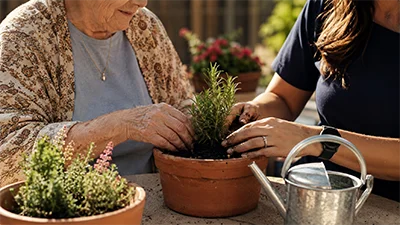
The first is more trusted orientation. In a 10 bed home, locals learn the design quickly, even with moderate dementia. The restroom is in one of 2 instructions, the kitchen area smells like coffee every early morning, and you can see the front door from the living room chair. Less options suggest less chance for confusion. People find their method without requiring to bear in mind abstract space numbers or color coded wings.
The second is reduced sensory overload. Televisions are simpler to manage. Staff conversations stay at regular volume. There are no overhead pagers announcing medication passes or visitor arrivals. Dining is at one or two tables, not a lunchroom. Hallways are much shorter, so individuals are less likely to experience a rush of wheelchairs, delivery carts, and visitors simultaneously. This calmer background lets the nervous system drop from "high alert" to something closer to baseline.
The third is more powerful relational memory. When just a handful of caregivers come through the door every day, residents construct emotional familiarity with them, even if they can not state their names. You will hear families state "Mom illuminate for Carla, you can simply see her unwind." That type of micro trust is more difficult to build when staff rotate through dozens of residents across several units in a shift.
A fourth impact is less abrupt transitions. Big facilities in some cases move citizens around like puzzle pieces: today in activity space A, tomorrow in dining room B, a various lounge when a family is going to, another wing if staffing changes. Smaller sized settings tend to have one main living area, one dining space, and bedrooms just a few steps away. The resident's world is meaningful and compressed.
All of this does not cure dementia. Individuals still ask repetitive questions or experience sundowning. What often changes is the intensity and frequency of nervous episodes. Households discover fewer emergency calls, less requirement for as required stress and anxiety medication, and more stretches of quiet engagement.
When a larger setting might be harder on anxiety
It is necessary to acknowledge that not every big assisted living or memory care neighborhood creates stress and anxiety, and not every little home is a haven. However, some particular features of big scale senior care environments can be challenging for people with dementia.
Corridor design frequently works against orientation. A long, double loaded hallway with similar doors on both sides is efficient for staffing, but ravaging for a disoriented resident. I have actually walked those corridors with individuals who stop at each door, unsure whether it conceals their own space, a restroom, or a stranger. They either give up and retreat to the lobby, or they keep opening doors and upsetting other residents.
Centralized dining rooms bring everybody together, which is great for performance and social programs, but meals are among the most typical flashpoints for stress and anxiety. The noise of dozens of people, clatter of dishes, staff on a tight schedule, and completing smells can overwhelm the senses. Citizens may stop eating, become agitated, or try to flee.
Complex staffing patterns include another layer. Larger operations usually have more layers of management, float staff, and agency employees. While that may support 24/7 protection, it also indicates residents see more unfamiliar faces among the few they recognize. Operationally, it makes good sense. Emotionally, it can feel like a turning cast of strangers.
Activity calendars in larger neighborhoods tend to be loaded: bingo, exercise classes, performers, trips. Structured engagement can assist, however consistent redirection from something to the next leaves some citizens exhausted. They may appear "resistant" when asked to join since they are overwhelmed, not antisocial.
When examining any senior care setting, it is useful to look past the marketing and count the number of various rooms, deals with, and shifts a resident should navigate just to make it through a regular day. If that count seems high, anxiety danger is probably high too.
Real world examples of change
I think about a retired mechanic I will call Robert. He got in a big assisted living neighborhood after a hospitalization. He was in early to mid phase dementia, still walking individually, however with word finding problem and great deals of pacing. His child selected a big place partially because of the features: a bar, theater, several patios. Within weeks, staff reported that he roamed behind the reception desk, tried to follow shipment drivers out the filling dock, and became combative in the dining room. He ended up on three new medications.
Six months later on, after a fall, his care group advised transfer to a 10 bed memory care home closer to his daughter. She thought twice, thinking it looked too easy, "insufficient going on." The very first week was rocky as Robert asked consistently where he was and "when do we go home." Caretakers answered him, walked him through your home, and put his old tool kit on the small patio. By the 3rd week, he paced primarily between his space, that patio, and the kitchen. He continued to ask repeated concerns, but reports of combative behavior dropped to near no. His physician stopped among the anxiety medications and decreased the dosage of another.
Not every story is this tidy, and not all enhancements hold permanently. Dementia continues its course. Yet I have seen sufficient cases like Robert's to feel great telling households that environment is not a shallow choice. It becomes part of the therapeutic plan.
How small is "little sufficient"?
Families typically request a number: "Is 20 homeowners too many? Is 8 the magic number?" The sincere answer is that there is no single cutoff. Other design and staffing elements matter simply as much as headcount.
When I visit a community, I pay attention to how many residents share one living area, and how frequently that group changes. A 24 resident memory care wing may work like 2 different houses of 12 each, with different dining spaces and consistent personnel. That can feel rather intimate. On the other hand, a 12 person home where personnel float regularly from another building, or where homeowners are constantly gathered into a bigger central room for activities, might feel bigger than the census suggests.
A useful approach is to stroll a normal daily course in your mind. For example, from bed to breakfast, to the bathroom, to a chair for early morning coffee, to lunch, to a quiet nap, to afternoon engagement, then to supper and night wind down. Count the number of separate spaces and staff faces your family member would experience. If each step adds a brand-new set of people and visual hints, the environment may be too complicated for somebody already overwhelmed.
Signs a smaller sized environment might help
Here is one of the 2 allowed lists.
Consider trying to find a smaller sized, more consisted of senior care setting if you observe several of the following in a present or suggested environment:
- Your relative becomes distressed or agitated in big group settings, particularly in busy dining-room or activity spaces.
- They frequently get lost in hallways or can not discover their room or the bathroom without hands on help.
- Staff consistently report "exit seeking" habits, especially heading toward stairwells, elevators, or filling docks after encountering hectic areas.
- Anxiety spikes at shift changes, when numerous brand-new staff deals with appear at once.
- Your relative calms significantly when relocated to a quieter corner, smaller sized table, or more homelike room.
These are not hard and fast rules, but they are great hints that an easier, smaller sized world might much better fit how the individual's brain now operates.
How smaller settings intersect with various care types
Understanding how smaller environments suit different types of senior care assists you weigh options realistically.
In assisted living, smaller sized environments are less typical, however you might find "neighborhood" designs where 10 to 15 houses share a small dining room and lounge, somewhat separated from the rest of the building. This can work well for older grownups who are just beginning to reveal dementia however still have significant independence. The trade off is that medical assistance may be lighter than in specialized memory care.
Memory care settings are where smaller sized environments can shine. Stand alone memory care group homes and family style systems purposefully shape their spaces to match what individuals with dementia can deal with. Households must not assume that all memory care is little, though. Some centers are rather large, with 40 or more locals in an open strategy. Always walk the area yourself.
Respite care is an effective tool when you are uncertain what environment will work best. An one or two week remain in a smaller group home or household model lets you observe how a loved one responds without making a permanent relocation. I have actually seen families alter course entirely after a respite stay, sometimes choosing that the big, remarkable campus they initially chose is not the best suitable for this stage of dementia.
Across all kinds of senior care, watch how the environment either strengthens or undermines the best efforts of caregivers. Even outstanding staff work uphill if the building constantly bombards homeowners with extreme sights and sounds.
Questions to ask when exploring smaller sized senior care homes
Here is the 2nd enabled list.
To judge whether a smaller assisted living or memory care home truly supports lower stress and anxiety, ask focused, practical questions such as:
- How numerous homeowners share this living and dining location, and is that number stable or does it alter often?
- How several caregivers will my member of the family typically see in a day and over a week?
- When a resident is distressed or pacing, where can they go that is peaceful but still monitored and safe?
- Are meals and activities versatile enough to enable somebody to step out if overwhelmed, without being left alone or forgotten?
- How do you support homeowners who roam or "exit look for" without right away resorting to medication or physical restraint?
Listen not only to the material of the answers but likewise to how rapidly personnel grab relational options. If every response focuses on locks, alarms, and sedating medications, the environment may not be as restorative as its little size suggests.
Trade offs and restrictions of smaller environments
Smaller is not instantly better. There are real trade offs that families must weigh carefully.
Cost can be higher on a per resident basis, especially in well staffed little homes with high staff to resident ratios. Without economies of scale, they may charge more than large assisted living or memory care neighborhoods for comparable levels of hands on care. On the other side, some small board and care homes run on really tight budgets, which can restrict activities, upkeep, or specialized personnel training.
Medical complexity is another factor. A person with advanced heart failure, complex wound care, or frequent hospital stays might need the scientific infrastructure that bigger centers or skilled nursing provide. A cozy 8 bed home may manage routine dementia care magnificently however be overwhelmed when someone needs nighttime CPAP modifications, tube feeding, or regular lab draws.
Social needs vary too. Not everybody craves a quiet, slow paced setting. Some citizens, particularly those with lifelong extroverted characters, brighten in bigger spaces with lots of people around. They still require structure, however too small an environment can feel suppressing or boring.
Regulatory oversight differs by state and region. Some little senior care homes are firmly controlled and inspected, others operate under looser guidelines compared to huge certified assisted living neighborhoods. Families need to examine examination reports, talk to regulators if possible, and not rely exclusively on appearances.
The goal is not to chase a perfect, however to match the environment to the specific person, including their medical requirements, personality, history, finances, and phase of dementia.
Practical actions for families thinking about a smaller sized dementia care setting
If you presume that a smaller environment would help in reducing your loved one's stress and anxiety, begin with observation. Hang out where they live now or in their existing routine. Notification when they appear most distressed. Track where they are, how many individuals are around, and what type of noise and movement fill the space at that moment. Patterns normally emerge within a couple of days.
Next, tour a few various types of small settings. Walk through at meal times and throughout shift changes, not simply throughout calm mid morning hours. Sit quietly in the common area for a minimum of 20 minutes and envision your relative attempting to follow what is taking place. Pay attention to your own body. If you feel overstimulated or puzzled by the comings and goings, it is not likely your loved one will feel more settled.
Bring particular circumstances to staff, not simply general concerns. For instance, "My mother tends to rate and request her parents every night around 5. How would that look here?" or "My father declines to go into crowded spaces. How would you get him to meals?" Staff who are comfy and thoughtful in their responses tend to operate in cultures that respect locals' psychological realities.
Finally, bear in mind that any move is itself a major stressor. Stress and anxiety typically increases for the very first week or more after moving, no matter how restorative the brand-new environment. Supplying familiar things, frequent comforting visits, and constant descriptions helps. With time, in a well matched little setting, that moving anxiety need to decrease rather than escalate.
A calmer world, not a perfect one
Anxiety in dementia will never ever disappear completely. There will still be nights when your father insists he needs to go to work, or afternoons when your wife ends up being convinced that someone has taken her bag. A smaller sized senior care environment can not eliminate the brain modifications that fuel those fears.
What it can do is remove much of the unneeded stress factors that a big, complex environment stacks on. With less hallways to get lost in, fewer complete strangers to analyze, and less sudden sounds to procedure, the brain is not pushed rather so non-stop to the edge of its capacity.
When that load lightens, something crucial emerges. People with dementia, even in moderate or later stages, often reveal more of their underlying personality in settings that feel safe and workable. You catch glimpses of humor, inflammation, and long deep-rooted routines that stress and anxiety had actually buried. A previous gardener sits happily near the yard flower beds of a little home. An instructor gently corrects a caretaker's pronunciation. A parent when again reaches out to comfort a checking out child.
Those moments are worth a lot. They do not simply make caregiving simpler. They maintain dignity, connection, and self in a disease that attempts to strip those away. For numerous families, picking a smaller sized senior care environment is not about high-end or aesthetics. It is about giving their loved one the very best possible chance to feel less scared worldwide they now inhabit.
Beehive Homes of Sandy provides assisted living care
Beehive Homes of Sandy provides memory care services
Beehive Homes of Sandy provides respite care services
Beehive Homes of Sandy supports assistance with bathing and grooming
Beehive Homes of Sandy offers private bedrooms with private bathrooms
Beehive Homes of Sandy provides medication monitoring and documentation
Beehive Homes of Sandy serves dietitian-approved meals
Beehive Homes of Sandy provides housekeeping services
Beehive Homes of Sandy provides laundry services
Beehive Homes of Sandy offers community dining and social engagement activities
Beehive Homes of Sandy features life enrichment activities
Beehive Homes of Sandy supports personal care assistance during meals and daily routines
Beehive Homes of Sandy promotes frequent physical and mental exercise opportunities
Beehive Homes of Sandy provides a home-like residential environment
Beehive Homes of Sandy creates customized care plans as residents’ needs change
Beehive Homes of Sandy assesses individual resident care needs
Beehive Homes of Sandy accepts private pay and long-term care insurance
Beehive Homes of Sandy assists qualified veterans with Aid and Attendance benefits
Beehive Homes of Sandy encourages meaningful resident-to-staff relationships
Beehive Homes of Sandy delivers compassionate, attentive senior care focused on dignity and comfort
Beehive Homes of Sandy has a phone number of (801) 975-5244
Beehive Homes of Sandy has an address of 9532 S 700 E, Sandy, UT 84070
Beehive Homes of Sandy has a website https://beehivehomes.com/locations/sandy/
Beehive Homes of Sandy has Google Maps listing https://maps.app.goo.gl/gxoX9vT5PFH9mJTP9
Beehive Homes of Sandy won Top Assisted Living Homes 2025
Beehive Homes of Sandy earned Best Customer Service Award 2024
People Also Ask about Beehive Homes of Sandy
What does assisted living cost at BeeHive Homes of Sandy?
BeeHive Homes of Sandy offers all-inclusive assisted living pricing. That means one straightforward monthly rate covering personal care, home-cooked meals, housekeeping, laundry, and daily support, with no hidden costs or surprise fees. Because we offer seasonal pricing and current availability can change, we invite families to call for up-to-date rates and any current offers. Before move-in, our team completes a personalized assessment of health, mobility, medication, and activities-of-daily-living needs, so we can confirm the right care plan and share clear pricing for your family.
Can residents remain at BeeHive Homes as their care needs change?
Yes. In almost all cases, residents can remain at BeeHive Homes of Sandy as their care needs change, aging in place in a familiar, homelike environment. Because we coordinate with third-party home health and hospice providers, residents can receive added care right in the home rather than relocating. It is very rare for a resident to need to move, and that typically happens only when someone requires continuous skilled nursing or hospital-level care beyond what an assisted living or memory care home can safely provide.
Is a nurse available at BeeHive Homes of Sandy?
Yes. BeeHive Homes of Sandy has a nurse who provides day-to-day oversight of residents and works directly with each resident's own physicians and healthcare providers to continue the best possible care. Residents may keep seeing their preferred doctors, and when ordered by a medical provider, home health, therapy, or hospice services can often be delivered directly in the home. Caregiver support is available 24 hours a day.
What are the visiting hours at BeeHive Homes of Sandy?
Visit anytime. At BeeHive Homes of Sandy, we would rather family come too often than not often enough, because strong family relationships are an important part of every resident's well-being. We simply ask that visits be respectful of the other residents who live here, along with each resident's meals, rest, and care schedule. If you would like to come very early or very late, just let us know in advance and we will make it work.
Are rooms available for couples at BeeHive Homes of Sandy?
BeeHive Homes of Sandy may have room options for couples who wish to remain together while receiving senior care. Availability depends on current openings, room size, and the care needs of both individuals. Please contact our team to discuss available accommodations and find the best fit for your family.
What services are provided at BeeHive Homes of Sandy?
BeeHive Homes of Sandy provides personalized assistance with bathing, dressing, grooming, mobility, medication management, meals, housekeeping, laundry, and other activities of daily living. Residents also enjoy private rooms, home-cooked meals, engaging senior activities, and caregiver support available 24 hours a day, all in a smaller, residential-style setting that feels like home.
Does BeeHive Homes of Sandy offer memory care and respite care?
Yes. BeeHive Homes of Sandy offers both memory care and assisted living. Our memory care supports residents living with Alzheimer's disease, dementia, or other cognitive changes. Short-term respite care is also available for recovery periods, caregiver relief, or families who want to experience BeeHive Homes before considering a long-term move. Availability and suitability are determined through an individual assessment.
How can I schedule a tour of BeeHive Homes of Sandy?
Call (801) 975-5244 to schedule a tour of BeeHive Homes of Sandy anytime. A personal visit is often the best way to experience our calm, homelike atmosphere, meet our caregivers, see the private rooms and shared spaces, and ask questions about assisted living, memory care, or respite care in Sandy, Utah. We would love to help you decide whether BeeHive Homes is the right next step for someone you love.
Where is Beehive Homes of Sandy located?
Beehive Homes of Sandy is conveniently located at 9532 S 700 E, Sandy, UT 84070. You can easily find directions on Google Maps or call at (801) 975-5244 Monday through Sunday Open 24 hours
How can I contact Beehive Homes of Sandy?
You can contact Beehive Homes of Sandy by phone at: (801) 975-5244, visit their website at https://beehivehomes.com/locations/sandy/
The Amphitheater Park offers a welcoming environment for families visiting loved ones receiving Assisted living, memory care, senior care, elderly care, and respite care.